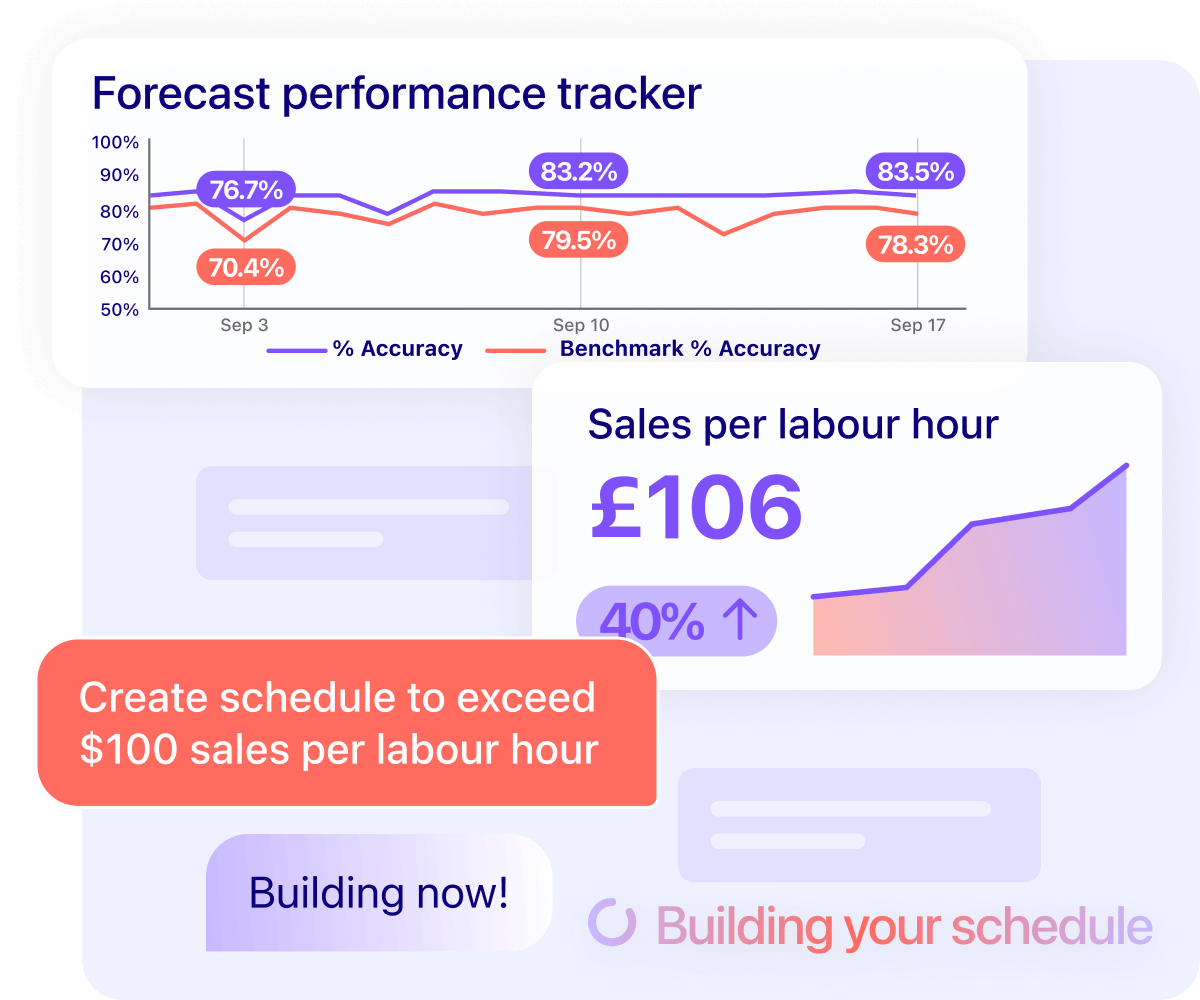
Deputy's forecasting and Smart Scheduling tools use business data like historical sales and footfall to help managers plan staffing; Deputy AI assists with rota tasks.
People work best in the loop. In the Deputy UK Big Shift Report 2026, 88% of shift workers say AI makes their job easier.
The biggest wins tend to sit around seasonal and bank holiday peaks, where over-staffing and under-staffing cost the most.
When you choose a tool, look for solid data integration, reviewable outputs, and manager control, not full automation.
Picture a quiet Tuesday afternoon with three too many people on the floor, then a Saturday rush that leaves you two short and everyone stretched. If you build rotas around shifting demand, you know that balancing staffing, labour costs, and real-time need is no easy job.
That's why more shift-based businesses are looking at AI labour forecasting for shift work. 78% of organisations now report using AI in at least one business function, according to the Stanford AI Index. Staffing is one place it can help managers act faster.
There's plenty of hype to cut through, though. The Deputy UK Big Shift Report 2026 found that 88% of United Kingdom (UK) shift workers say AI makes their job easier. Yet only 42% report a meaningful reduction in stress.
The takeaway is simple: success won't come from replacing people with software, but from pairing your team with tools that support their judgement.
How AI labour forecasting for shift work supports managers
Labour forecasting uses business data and configured demand metrics to help estimate staffing requirements. AI-assisted scheduling can then support managers with parts of the rota-building process. Instead of staring at last year's spreadsheet and guessing, you get information to review, adjust, and sign off.
The key word is assisted. The tool surfaces patterns and generates suggestions, and you stay the decision maker.
It can help you spot a likely rush before it lands, but it can't feel the mood of your floor on a wet bank holiday. That's still your call. Good AI labour forecasting for shift work leans on both.
The data your rota already holds
Most of what a forecast needs is already sitting in your systems. This is the groundwork for AI-assisted demand forecasting, which reads that history and turns it into a draft estimate for you to review.
Sales history: past takings by day, hour, and site to reveal your true busy periods
Footfall or configured demand metrics: transactions or customer counts that show demand your till totals alone can miss
Manager context: managers can also factor in information the system may not account for, such as local weather, fixtures, festivals, and bank holidays.
Manual and auto-scheduling versus AI-assisted forecasting
It helps to see these as points on a spectrum rather than rival camps.
Manual planning: you build the rota yourself using available business information.
Forecasting and labour modelling: you use business data and configured metrics to estimate demand and staffing requirements.
Auto-scheduling: you set configured scheduling requirements, and the tool helps build the rota.
Deputy AI: you make natural-language requests, and it assists with supported scheduling tasks, subject to manager review.
What's real and what's hype with AI forecasting
AI can work through large amounts of data in minutes and retire a lot of tired spreadsheets. Not every method is equal, though, and your business still runs on people. So what genuinely helps, and what's just noise?
Where AI-assisted forecasting genuinely helps managers
Labour forecasting can eat a manager's week. Hours vanish into workbooks that could go to coaching staff and building an engaged team. Used well, AI-assisted rota planning can help give managers some of that time back.
Smarter scheduling support: Deputy's forecasting and Smart Scheduling tools use business data to help managers understand staffing requirements, while Deputy AI assists with rota tasks.
Labour cost visibility: Deputy's scheduling and Business Insights tools show managers scheduled labour costs alongside forecast sales before the rota is published.
Closer alignment with demand: matching planned cover more closely to forecast demand can help managers make more informed staffing decisions.

Where AI alone falls short
AI isn't a silver bullet. A forecast is only as good as the data behind it, and it can't read the human side of a shift. That's why your people need to stay in the loop.
If your workforce data is inconsistent and spread across several tools, the draft forecast won't be reliable.
If AI suggestions go out without human oversight, errors slip through, and workers can lose trust in the rota.
When managers lean too hard on the tool, they can miss the small moments that keep a team connected.
Trust matters here. The Deputy UK Big Shift Report 2026 found that 76% of workers say AI tools are not fully transparent in how they are used.
Alongside that, 55% believe AI could replace part or all of their job, even though only 9% have seen AI-linked job losses first-hand. Treat the tool as an assistant that gives you foresight, not a replacement for your read of the room.
Better together: people and AI make labour forecasting better
Labour forecasting works best when managers and AI work in tandem. Rather than automating every step, pairing draft forecasts with human insight keeps decisions grounded in the knowledge, experience, and empathy your team brings.
That's what makes people and AI genuinely better together. It moves you away from reactive rota-filling towards proactive planning, with AI supporting the people who make the calls.
AI lends speed and foresight, helping you find patterns, estimate peaks, and clear manual admin.
People bring the empathy a tool can't, knowing the team and the right person for each shift.
Together, they can help shifts run more smoothly, with steadier staff and fewer scheduling headaches.
Workers draw a clear line, too. The Deputy UK Big Shift Report 2026 found that around 40% of workers support AI assisting them, against 32% opposed. But only 25% support AI in decisions such as hiring, progression, or dismissal, with 55% against.
In short: people welcome AI that supports how work gets done, and resist AI that replaces human judgement.
How managers can use Deputy AI in shift planning
Managers need a planning starting point they can review and adjust. Deputy built Deputy AI to support that process without displacing the human connection at the heart of shift work.
AI-assisted scheduling: Deputy AI can assist authorised managers with supported rota tasks using natural-language requests.
Demand insights: Deputy's forecasting and Smart Scheduling capabilities can help managers understand forecast demand and staffing requirements.
Labour-cost visibility: Deputy's scheduling insights can help managers view labour costs alongside relevant business metrics.
Managers often make the move for one shared view. Matthew Bell, Hotel Operations Director Europe at citizenM, says the switch gave his European hotels a single source of truth:
We had issues around the equality of shifts and around having a single source of truth. If someone changed a shift in Excel, did everyone actually see the updated version?